Ovulation Test vs Pregnancy Test: When to Use Each


Summarise this article with AI


Ovulation tests and pregnancy tests look almost the same on the shelf, but they answer two very different questions at two different points in your cycle. In this article, RAF Pharmacy breaks down the difference between ovulation tests and pregnancy tests, explaining what each test detects, how they work, and when to use them.
Quick answer: An ovulation test helps you find your most fertile days before you try to conceive. A pregnancy test tells you whether you are pregnant after a missed period. One looks ahead, the other looks back, so one cannot replace the other.
Ovulation vs Pregnancy Tests: Understanding What Each Test Measures
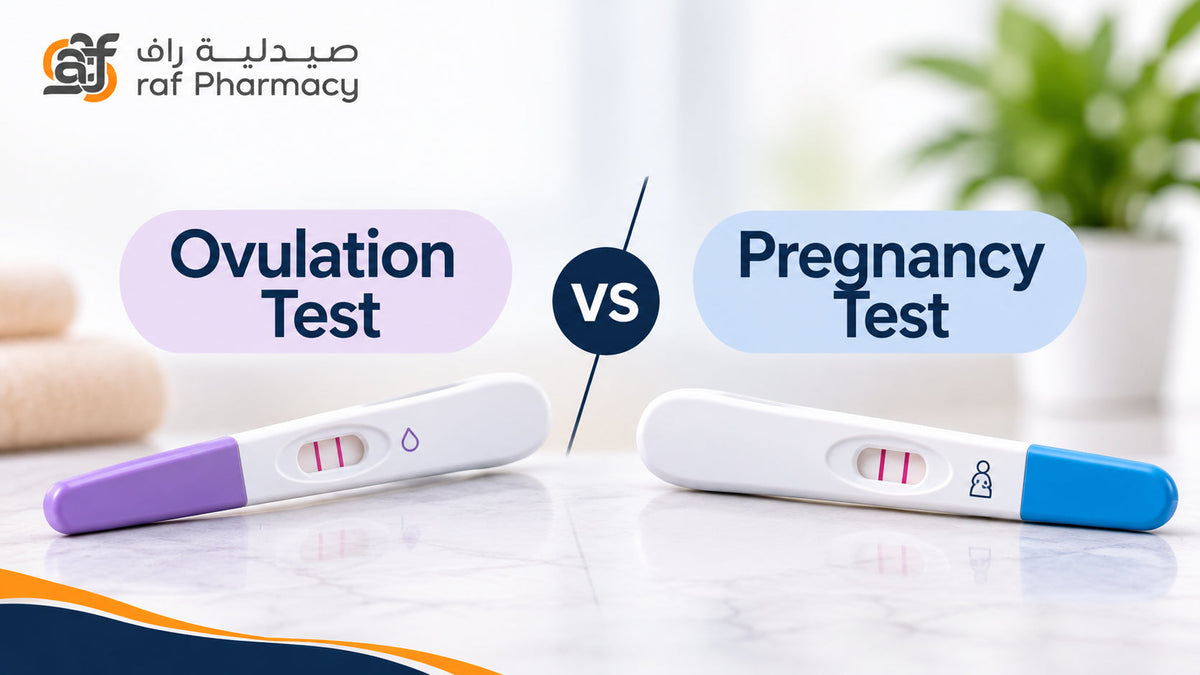
The main difference between ovulation and pregnancy tests is the hormone each one looks for. Ovulation tests detect luteinising hormone (LH), and some also detect oestrogen. Pregnancy tests detect human chorionic gonadotropin (hCG), a hormone the body mainly makes once a pregnancy has begun.
[Image: side-by-side graphic of an ovulation test and a pregnancy test]
Alt text: Ovulation test and pregnancy test side by side, showing LH and hCG detection
Here is the ovulation test vs pregnancy test comparison at a glance:
-
Hormone: LH for ovulation tests, hCG for pregnancy tests
-
When to use: mid-cycle for ovulation tests, from the day your period is due for pregnancy tests
-
Question answered: "When am I most fertile?" versus "Am I pregnant?"
How Ovulation Tests Work
Shortly before an egg is released, the body produces a sharp rise in LH, known as the LH surge. Ovulation tests pick up this surge in urine. According to MedlinePlus, a positive result means you should ovulate within the next 24 to 36 hours, although this is not true for every woman.
The egg survives for about 12 to 24 hours after release, while sperm can survive for up to five days, sometimes longer. That makes your fertile window roughly six days long: the five days before ovulation plus the day of ovulation itself.
How Pregnancy Tests Work
Once a fertilised egg attaches to the lining of the womb, the body starts producing hCG, and a home pregnancy test detects it in urine. The Office on Women's Health explains that most home tests can accurately detect pregnancy after a missed period, and that first-morning urine can improve accuracy.
Testing too early is a common reason for a false negative. The US Food and Drug Administration notes that 10 to 20 pregnant women out of every 100 will not detect their pregnancy on the first day of a missed period. If your result is negative and your period still has not come, test again a few days later.
When to Use an Ovulation Test Depends on Your Cycle Length
MedlinePlus suggests starting 3 to 5 days before your expected ovulation. Ovulation usually happens around 10 to 16 days before your next period (about 14 on average), counting day 1 as the first day of bleeding:
-
28-day cycle: ovulation around day 14, so start testing on day 10 or 11
-
32-day cycle: ovulation around day 18, so start testing on day 14 or 15
If your cycle length changes a lot each month, start based on your shortest recent cycle.
[Image: 28-day cycle timeline]
Alt text: 28-day menstrual cycle timeline showing ovulation testing days and the fertile window
The Best Time to Take an Ovulation Test Is the Same Time Each Day
The best time to take an ovulation test depends on the brand. Some digital tests ask for first-morning urine, while others work at any time of day, so read the leaflet first. Test at roughly the same time daily, avoid drinking lots of fluid just before, and keep testing until you see a positive result, as the surge can be short.
How to Track Ovulation Using More Than One Sign
If you are learning how to track ovulation, combine a few simple methods:
-
Cycle diary: note the first day of each period to learn your usual cycle length
-
Ovulation tests: catch the LH surge as it happens
-
Cervical mucus: clear, slippery mucus often appears on your most fertile days
-
Basal body temperature: a small rise confirms ovulation has already happened
Ovulation tests and ovulation thermometers are available in RAF Pharmacy's pregnancy and fertility range. Conditions such as polycystic ovary syndrome (PCOS) can keep LH levels high, which may cause repeated positive results that do not mean ovulation is happening. If your results are confusing, or you get positives on many days, speak to your doctor.
Ovulation Test vs Pregnancy Test Depends on Where You Are in Your Cycle
Not sure which one you need today? Use these simple rules:
-
Trying to conceive and your period ended recently: use an ovulation test
-
Your period is late: use a pregnancy test
-
Negative pregnancy test but still no period: repeat the pregnancy test in a few days
Private Testing and Advice in Qatar
Home testing lets you check privately and at your own pace. Both tests are available to order for home delivery. If you are unsure about your results or need further guidance, our pharmacist is available to assist you privately via WhatsApp. After a positive pregnancy test, book a visit with your doctor or local health centre to confirm the result and start antenatal care.
Where to Buy Ovulation and Pregnancy Tests in Qatar
A few options listed at the time of writing:
-
Clearblue Digital Ovulation Test 10'S: QAR 269
-
Artron One Step Ovulation Urine Test 1'S: QAR 24
-
Clearblue Rapid Pregnancy Test 1'S: QAR 59
-
Clearblue Digital Ultra Early Pregnancy Test 1'S: QAR 73
Compare the full range of home pregnancy tests, from cassette strips to digital tests. Orders come within 1 to 2 hour express delivery and free delivery above QAR 59.
Choosing the Right Test at the Right Time
Ovulation tests and pregnancy tests are designed for different stages of your cycle. An ovulation test detects the LH surge and helps you identify your most fertile days when you are trying to conceive. A pregnancy test detects hCG and gives the most reliable result after a missed period. Using each test at the right time gives you clearer, more accurate results.
If you are unsure which test is right for you, or need help reading your results, the pharmacists at RAF Pharmacy are available to guide you. Both tests can be ordered for home delivery across Qatar.
Frequently Asked Questions
What is the difference between an ovulation test and a pregnancy test?
The difference is the hormone. An ovulation test detects LH to predict your most fertile days before conception. A pregnancy test detects hCG, which the body mainly makes after a pregnancy begins.
Why do I keep getting positive ovulation tests?
Repeated positives can happen when LH stays high for longer than a typical surge, which is common with polycystic ovary syndrome (PCOS). Reading a strip after the time stated on the leaflet can also give a false positive. If you see positives on many days in a row, speak to your doctor.
Does a faint line count as a positive result?
It depends on the test. On an ovulation strip, a faint line does not count: the test line must be as dark as or darker than the control line. On most pregnancy tests, any visible test line read within the time on the leaflet counts as positive, even if it is faint.
Can an ovulation test detect pregnancy?
No. Ovulation tests are designed to detect LH, not hCG. Because the two hormones are similar in structure, an ovulation test may sometimes show a line in pregnancy, but only a pregnancy test gives a reliable answer.
How can you use ovulation tests to track your fertile window?
Test daily from a few days before expected ovulation until you get a positive result. The day of the positive and the following day are usually your most fertile days.